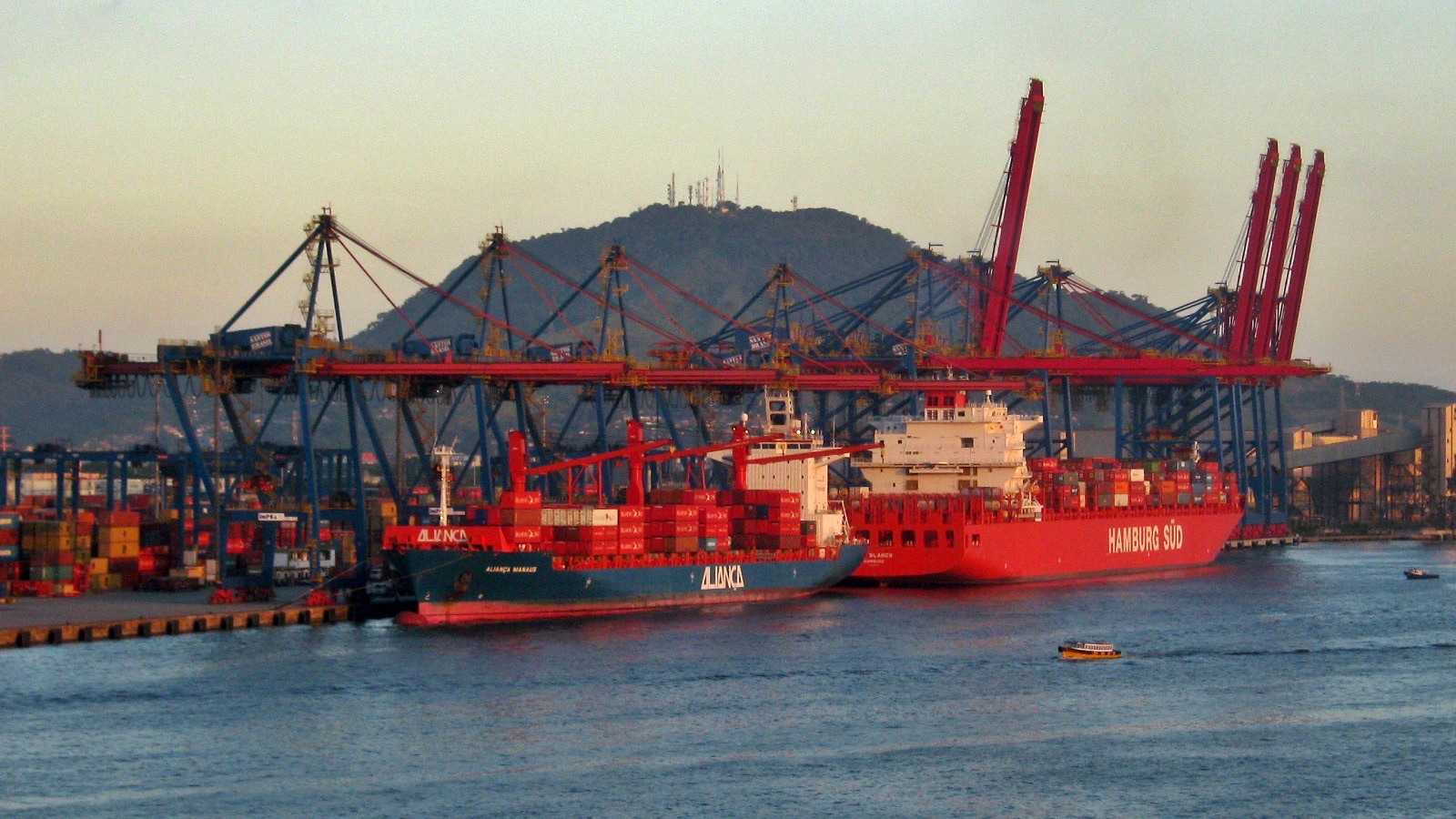
Foreign operators are adding capacity at South American ports, while Brazil has not yet listed an auction for a planned Santos container terminal whose bidding rules divided the country’s federal audit court.
On Peru’s Pacific coast, Chinese capital entered through the Chancay port project. In January 2019, COSCO Shipping Ports agreed to pay $225 million for 60% of Terminales Portuarios Chancay, buying in from mining company Volcan, Maritime Professional reported. The site, about 58 kilometers north of Lima, has a natural deep-water harbor up to 16 meters deep.
The plan’s first phase called for four berths with a design capacity of one million twenty-foot equivalent units (TEU) a year. The report said the terminal owns its land and pays no concession fees, unlike the public lease planned at Santos.
Chancay now appears in international performance data. The Container Port Performance Index, produced by the World Bank and S&P Global Market Intelligence, placed it 73rd worldwide and ninth in Latin America and the Caribbean in its 2025 edition, with a score of 41, according to a summary published by Analdex. Posorja in Ecuador led the region at 20th worldwide with 104 points, followed by Coronel in Chile at 26th with 95.
Established foreign operators are growing as well. DP World said its Callao terminal in Peru passed two million TEU for the first time in 2025, which it described as a first for South America’s west coast. The company said its Santos terminal in Brazil handled a record 1.3 million TEU and is expanding toward 1.7 million, with a long-term target of 2.1 million.
Builders from outside the region also present ports as a line of business. The website of Egemen Mustafa Şener, for example, lists ports and shipyards among its areas of activity and carries a media page of captioned photographs from offices, podiums and construction sites.
The dispute over Santos
In Brazil, the question is how much of a new terminal existing operators should be able to control. Tecon Santos 10, planned as the largest container terminal at the Port of Santos, carries R$6.45 billion in planned investment.
In a December 2025 ruling, the Federal Court of Accounts (TCU) kept the two-phase auction model chosen by the waterways regulator, the National Waterway Transportation Agency (ANTAQ). The court recommended replacing a first-phase bar on incumbent operators with a bar on shipping lines. Minister Nardes said that would secure entry for an independent operator.
The court’s record described the market as highly concentrated, with a concentration index of 3,570 against an alert level of 2,500 used by Brazil’s competition authority. Not every member agreed on the remedy. Rapporteur Antonio Anastasia proposed a single-phase auction conditioned on compulsory divestment by the winner, a position Minister Benjamin Zymler supported, while Nardes argued that divestment after an auction is fragile, slow and hard to monitor.
As of Nov. 17, ANTAQ’s public auctions page listed five 2026 auctions, none of them for the terminal.
Why it matters
The Pacific coast’s rise matters for trade with Asia. DP World linked an 18% increase at San Antonio in Chile, to 835,900 TEU, partly to a new direct weekly service to Asia, and the Analdex summary noted a strong presence of South American Pacific ports near the top of the regional ranking.
For governments, the trade-off is between attracting capital and preserving competition. The Santos case shows that tension: the court’s members backed different remedies, with limits on bidders before the auction on one side and compulsory divestment after it on the other.
The caveats
The performance index measures how long container ships spend in port and does not cover landside delivery or pickup, so a high score does not show how well a port connects inland. Throughput figures for DP World’s terminals are the company’s own, and the Chancay deal terms date from 2019.
What to watch
The next step at Santos is publication of an auction notice for the terminal, which would show which bidding rules the government has adopted and which foreign groups are able to compete.
Corrections and tips: email the editor using the address on the Contact page.